
What Is AEO? AI SEO Explained For Local Businesses
Your customers have started asking AI assistants for recommendations. Here’s how the answers get chosen, and how to make sure your business is in them.
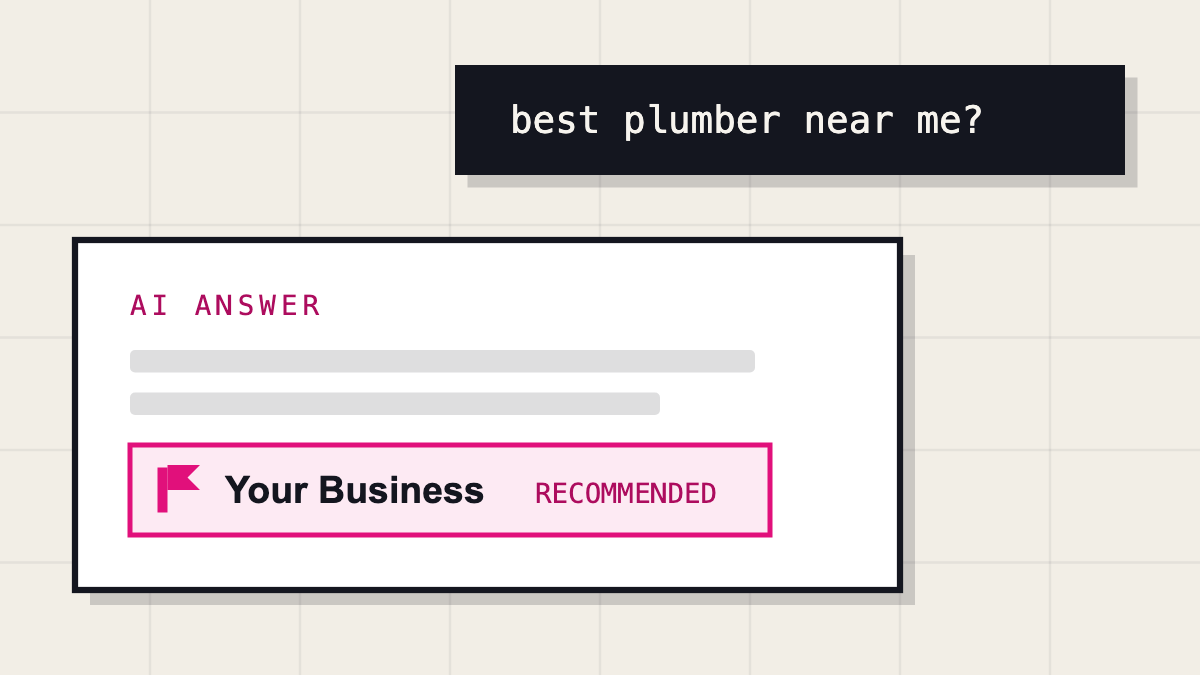
Ask ChatGPT for “a good emergency plumber in Leeds” or let Google’s AI Overviews answer “best aesthetics clinic near me”, and you get something very different from ten blue links: a short answer naming a handful of specific businesses. There is no page two of an AI answer.
AEO, GEO, AI SEO: What’s The Difference?
None worth arguing about. Answer Engine Optimisation (AEO), Generative Engine Optimisation (GEO) and AI SEO all describe the same discipline: optimising your business to be recommended in AI-generated answers. The label will settle eventually; the work is what matters.
How Do AI Assistants Choose Businesses?
AI systems compose answers from what they can read and verify across the web. In practice, a few signal groups dominate for local questions:
- Structured data: schema markup that spells out who you are, what you do, where you are, your opening hours and your FAQs, in a format machines parse reliably.
- Consistency: your name, address, phone and service claims matching everywhere: your site, Google Business Profile, directories, citations. Contradictions breed doubt, and doubtful businesses don’t get recommended.
- Answer-ready content: clear, factual passages that directly answer real questions. Assistants lift quotable blocks, not marketing waffle.
- Reviews and reputation: genuine review volume and sentiment across trusted platforms, the same prominence signals that drive the map pack.
- Crawlability: assistants can only cite what their crawlers can reach. Fast, clean, semantic sites with open access get read; bloated ones get skipped.
Why Local Businesses Should Care Early
Local questions are exactly the kind people ask assistants: conversational, specific, urgent. And because the answers draw heavily on local signals you control, this is a game a well-optimised independent business can win against bigger names. The businesses that get their entity data and answers in shape now become the ones assistants keep recommending, and incumbency compounds.
What To Do About It
Start with the foundations: if your local SEO is solid, you’re most of the way there, because the map pack and the assistants trust the same signals. Then layer on the AEO specifics: comprehensive schema, an honest FAQ page that answers real questions, consistent citations, and monitoring of what the assistants actually say about you.
That’s precisely what our AI SEO service does, as a fourth pillar on top of local SEO, not a replacement for it. If you’d like to know what the assistants currently say about your business, ask us on a discovery call: the audit is often eye-opening.
Why This Is Different From Ranking
A results page gives you ten links and a scroll. An assistant gives you a paragraph and two or three names. That single change does most of the work of explaining why AEO matters: the tail of positions that used to produce some traffic produces none, and the cost of being nearly good enough goes up sharply.
The second difference is verification. A search engine ranks pages. An assistant is trying to decide whether a claim is safe to repeat, which means it is looking for agreement between sources. If your website says one thing, your Google Business Profile says another and a directory says a third, you are not just failing to rank, you are actively giving a model a reason to name a competitor it can be more confident about.
What Makes A Business Easy For An Assistant To Recommend
A clear entity. One unambiguous business, with the same name, address, phone number and description everywhere it appears, and structured data that states plainly what it is, what it offers and where. Ambiguity is the enemy: two slightly different business names across the web is enough to cause problems.
Quotable passages. Content that answers a specific question in a self-contained paragraph, near the top, in plain language. Assistants lift passages. A page that buries its answer in the ninth paragraph after a preamble about the company's journey will not be quoted, however well written it is.
Corroboration. Reviews, mentions and listings on sources the model already trusts. This is the same prominence that drives local rankings, and it is the hardest part to fake, which is precisely why it carries weight.
Access. A site that is fast, crawlable and not blocking the crawlers that feed these systems. It is worth checking: plenty of businesses have quietly blocked AI crawlers through a plugin default or a security setting and have no idea.
What Nobody Can Promise You
Nobody can guarantee that ChatGPT will recommend your business. These systems are probabilistic, they change without notice, and two people asking the same question in different words can get different answers. Anyone selling a guaranteed AI ranking is selling something that does not exist.
What is achievable is making your business the easiest one in your area to verify, quote and recommend, and then actually checking what the assistants say about you month to month so the work goes where the gaps are. That is a discipline, not a trick.
Where To Start If You Do Nothing Else
Complete your Google Business Profile properly, including categories, services, hours and photographs. Make your business details identical everywhere they appear. Get reviews arriving steadily rather than in bursts. Add a short, plainly written answer to the top of each of your main service pages. Those four things account for most of the available gain, and none of them require an agency.